
Let’s be real for a second. Every single peptide seller out there has got an answer for “how long till I see something.” Two weeks for recovery. A month for the fat to melt off. Six weeks and you’ll swear you got a new body. Confident numbers, every time. So I did what any stubborn person with an internet connection would do: I went and checked whether those numbers came from an actual study or from whoever writes the sales copy.
Here’s what I found, plain and simple. There are really two timelines floating around out there, and they don’t come from the same place. One’s built on paperwork, actual trials, actual measurements, actual years of somebody watching what happens to real people. The other one’s built on guesswork, and dressed up to look like paperwork. Once you can tell those two apart, the whole industry gets a lot easier to read.
The paperwork timeline versus the guesswork timeline
A timeline you can trust doesn’t come from a forum post or a slick product page. It comes out of a clinical trial, where somebody gave a set dose to real folks, wrote down what happened, and published it where anybody can go check their work.
For the peptides that actually made it through FDA approval, that paperwork exists. Tirzepatide is a good example. In the SURMOUNT-1 trial, published in the New England Journal of Medicine, the big result showed up at 72 weeks, that’s a year and a half, not a month. Folks lost an average of 15.0% of body weight on the 5 mg dose, 19.5% on 10 mg, and 20.9% on the 15 mg dose, compared to 3.1% on placebo [1].
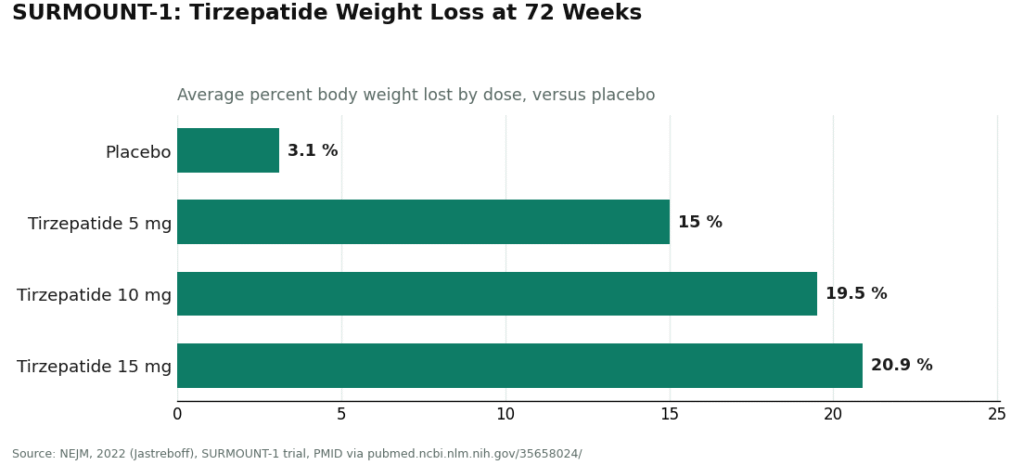
Sit with that for a second. That headline number came after a year and a half of slow, careful dose increases with a doctor watching the whole way. That’s the paperwork timeline: patient, gradual, and a lot less flashy than the ads make it sound.
Now flip over to the peptides folks are buzzing about online, BPC-157 being the biggest one. I went looking for its equivalent paperwork and there just wasn’t much of one. A 2025 systematic review in the HSS Journal dug through 36 studies on it, found that 35 were done in animals or petri dishes, only one was an actual small human study of 12 people, and came right out and said “no clinical safety data were found” [2]. A separate 2025 review found the same thing, only three pilot human studies exist on the compound, period [3]. So when somebody tells you BPC-157 “kicks in around two weeks,” ask them: based on what human study? Because there isn’t one. That number is either borrowed from a lab rat’s timeline or somebody’s cousin’s Instagram story. To say it plain, BPC-157 has mostly been studied in animals for tissue repair, not proven or approved for use in people.
That’s finding number one. The approved stuff has real paperwork, and it takes longer than the ads say. The gray-market stuff has confident timelines built on nothing but guesswork.
Even the folks studying this stuff are saying it out loud
I didn’t want this to just be me being suspicious, so I went and found the people who actually research this for a living. Turns out they’re blunter about it than I was.
Flynn McGuire, a chief medical resident at University of Utah Health, told STAT flat out: “The amount of hype to evidence is just so skewed, it’s crazy” [4]. Let that sink in, because it’s the whole ballgame here. When the hype’s running that far out ahead of the evidence, every single “results in X weeks” claim you see is just hype wearing a white coat. And it gets thinner still. STAT found that the great majority of the roughly 200 BPC-157 studies on PubMed share a research group or close colleague as a main author, which other researchers flagged as a real confirmation-bias risk [4]. So even the little bit of human evidence out there is leaning on itself. That’s not the kind of foundation you want holding up a promise about your own body.
Finding number two: the people closest to this research are telling us themselves that the hype and the evidence have gone their separate ways. Every sales-page timeline you see is riding on the hype side of that split.
What you’re actually buying when nobody checked the vial
Here’s where things got a little uglier for me. If the timeline’s made up, what else might be? So I looked at what actually lands in your mailbox when you order one of these research-chemical peptides, and the honest answer is: you don’t get to know.
These products aren’t reviewed by the FDA for identity, strength, quality, or purity. Nobody’s releasing batches, nobody’s issuing a real certificate of analysis, there’s no recall system if something’s wrong. Those certificates sellers post online are documents they chose to hand you, not proof from an independent party. Matthew Fedoruk, chief science officer at the U.S. Anti-Doping Agency, said it about as plain as anybody could: “You don’t even know what you’re buying inside that bottle. It could be a peptide. It could be a steroid. It could be something just like water” [4]. Now hold that up against a promised results date. How’s anybody supposed to guarantee you a timeline when nobody can guarantee what’s actually in the vial? They can’t. The timeline and the product are both a leap of faith.
And there’s a legal wrinkle worth knowing about too, because it decides what’s even legally on the table. BPC-157 sits under the WADA S0 Unapproved Substances list, “is not approved for human clinical use by any global regulatory authority,” and according to the FDA, compounding pharmacies have no legal basis to make it [5]. That’s not a compound with a settled timeline. That’s a compound with a contested legal status and barely any human data behind it, which makes any confident “here’s exactly when you’ll feel it” claim about it doubly hollow.
The real timelines, and what comes attached to them
Now, I’m not here to tell you none of this works, because that’d be its own kind of dishonest. The approved peptides do have real, documented effects on a real timeline. The catch is that timeline comes bundled with real medicine, and real medicine comes with real responsibilities attached.
Those SURMOUNT-1 results happened under medical supervision, slow dose increases, monitoring, and in a defined group of patients. And the approved drugs carry serious warnings that explain exactly why that supervision matters. Semaglutide’s label carries a boxed warning, the most serious kind the FDA hands out, for thyroid C-cell tumors, and it’s off the table for anybody with a personal or family history of medullary thyroid carcinoma or MEN 2 [6]. In other words, a real timeline and real medical oversight are the same package deal. You don’t get the documented result while skipping the process that produced it.
This is exactly what the gray market flips upside down. It sells you the result while stripping out everything that made the result trustworthy in the first place. No doctor, no dose titration, no screening, no verified product, and a timeline pulled out of thin air. Laid out like that, the appeal of ordering peptides off some website mostly dries up. You’re paying money for a number nobody’s willing to stand behind.
So what should you actually expect?
After digging through all this, here’s the honest expectation I’d give you, the one you won’t find on any product page.
If you’re using an approved peptide under a doctor’s care, expect a slow build, months not days, with dose changes along the way and somebody watching for trouble. Expect results in the range the trials actually showed, in the kind of patients the trials actually studied, not the dramatic before-and-after in the ad. That’s a real, defensible expectation to carry.
If you’re eyeing a research-chemical peptide instead, be honest with yourself about what you’re doing. The timeline you were sold has no human evidence behind it, nobody’s verified what’s in the bottle, and nobody’s monitoring you while you find out. Whatever happens to you happens with no map. That’s not a results timeline. That’s a gamble somebody slapped a number on to make it feel like a plan.
And if you want the documented, paperwork kind of timeline without going in blind, the path is a process that includes an actual clinician, an actual prescription, and a licensed pharmacy filling it, the supervised lane the law actually built for medicine. FormBlends is one outfit that operates that way, connecting patients with licensed physicians and dispensing through licensed compounding pharmacies instead of shipping you an unregulated chemical. I’m bringing it up once, as an example of what the supervised path looks like, not as a pitch. The thing that held up through all my digging is structural, not brand-related: a real timeline comes out of a real process, and the gray market’s whole business model is skipping that process.
One honest caveat before I let you go, because I don’t want to become the thing I set out to call out. Being supervised doesn’t turn a compounded peptide into an FDA-approved drug, and the FDA spent 2026 warning companies, 30 telehealth firms in March alone, against making it sound like it does [7]. What supervision buys you is a real clinician, real screening, a verified supply chain, and follow-up care. It doesn’t buy you a guarantee. And anybody promising you a guaranteed date on the calendar, for weight loss or anything else, is selling you the same made-up story I went looking for and couldn’t find any proof of.
The honest timeline is the one nobody’s selling: slower than the ad and wrapped in real medicine for the peptides that got proven, and flat-out unknown for the ones where nobody ever collected the evidence to know.
The usual questions
How long does it actually take for peptides to work? Depends entirely on whether it was ever tested on people. For approved ones like tirzepatide, the documented timeline is slow and measured in months, the big SURMOUNT-1 result showed up at 72 weeks after gradual dose increases under a doctor’s care, not in a few weeks. For research-chemical peptides, there’s no honest answer to give you, because the human trials that would establish a timeline were never run.
Does BPC-157 really “start working” in two weeks like people say? Nothing backs that up. A 2025 systematic review of 36 BPC-157 studies found 35 were preclinical (animal or lab) and only one was a small human study of 12 people, concluding no clinical safety data were found. Any “starts working in X weeks” line you hear about BPC-157 is coming from animal research or somebody’s personal story, not human data.
Why do the approved peptides take so long when the ads promise faster? Because the results people cite came from slow dose increases, medical monitoring, and defined patient groups over the whole length of the study. Those big numbers are the end-of-study figures, reached after a year or more of careful, supervised titration, not something that shows up in the first few weeks. The fast timelines in ads live squarely on the hype side of the gap researchers themselves have pointed out.
Can a faster result be safe without a doctor watching? The real risk isn’t just speed, it’s that you can’t verify what you took or how your body’s actually reacting to it. Unapproved research-chemical peptides aren’t reviewed by the FDA for identity, strength, quality, or purity, and there’s nobody keeping an eye on you. A quicker-feeling result without screening, dose titration, or follow-up strips out the exact safeguards that made the documented results trustworthy to begin with.
Does a supervised peptide mean a faster, guaranteed result? No. Supervision gets you a real clinician, real screening, a verified supply chain, and follow-up, not a guarantee on any timeline. The FDA spent 2026 warning companies, including 30 telehealth firms in March, against implying that a supervised compounded peptide is the same as an FDA-approved drug. Anybody promising a guaranteed date on the calendar is selling fiction.
So what timeline should I actually go in expecting? Under medical supervision with an approved peptide, expect a gradual build measured in months, with dose adjustments along the way and a doctor watching for issues, landing you in the range the trials showed. With a research-chemical peptide, expect no reliable timeline at all, because the human evidence to build one simply doesn’t exist yet.
Are peptides legal to buy in the US in 2026?
Depends entirely on which peptide and how you’re getting it. Some, like certain collagen peptides sold as supplements, are perfectly legal to pick up off a shelf. Others, like BPC-157 or CJC-1295, sit in murkier territory, the FDA hasn’t approved them as drugs, and the agency has moved to keep compounding pharmacies from using several of them. Ordering them online as “research chemicals” is technically legal for non-human use, but injecting them into yourself is a whole different story, legally and medically.
Are peptides legal in sport, and will they show up on a drug test?
Most performance-relevant peptides, including growth hormone releasing peptides and IGF-1 stimulating compounds, are banned by WADA and most major sporting bodies, in and out of competition. Detection windows shift depending on the compound and the test, and labs keep getting better at catching this stuff. If you compete at any level with drug testing, assume it’s banned until you’ve got that in writing from your sport’s governing body.
Are peptides legal in the military?
Active-duty folks are held to strict DoD supplement and substance rules, and unapproved peptide compounds fall well outside what’s allowed. Beyond the rulebook, there’s a practical worry too, using an unverified injectable could mess with a security clearance or a medical fitness status. Military supplement guidance generally points people toward FDA-approved treatments through their own healthcare providers, not gray-market peptide sellers.
What’s actually the legal way to get prescription-grade peptides in 2026?
The clearest legal road is a licensed physician writing you a prescription that goes to an accredited compounding pharmacy. That means a real diagnosis, real medical oversight, and a pharmacist accountable to a state board. FormBlends runs on this model, which is a genuinely different thing from a website selling peptides behind a “for research use only” disclaimer. The compounding rules are shifting fast as FDA guidance tightens up, so what was compoundable last year might not be this year.
References
- SURMOUNT-1 tirzepatide for obesity: 15.0% (5 mg), 19.5% (10 mg), 20.9% (15 mg) at 72 weeks vs 3.1% placebo. NEJM, 2022 (Jastreboff). https://pubmed.ncbi.nlm.nih.gov/35658024/
- Systematic review of 36 BPC-157 studies (35 preclinical, 1 clinical of 12 patients); “no clinical safety data were found.” HSS Journal, 2025. https://journals.sagepub.com/doi/abs/10.1177/15563316251355551
- Human safety and efficacy data for BPC-157 are extremely limited; only three pilot human studies exist. Current Reviews in Musculoskeletal Medicine, 2025.
- Hype-to-evidence gap (McGuire); most BPC-157 research traces to one research group; Fedoruk “could be something just like water” quote. STAT, Feb 3, 2026.
- BPC-157 prohibited under WADA S0; not approved for human clinical use by any global regulatory authority; per the FDA no legal basis for compounding pharmacies to use it. USADA, 2026.
- Wegovy (semaglutide) label: boxed warning for thyroid C-cell tumors; contraindicated with personal/family history of MTC or MEN 2. DailyMed.
- FDA warns 30 telehealth companies against illegal marketing of compounded GLP-1s; sameness claims cited. FDA press announcement, March 3, 2026.
Written by Junia Bianchi, health-data reporter. Not a doctor, just a reader who chases the paper trail. Last reviewed February 2026.
Not professional medical advice. Speak with your healthcare provider before making a change.